
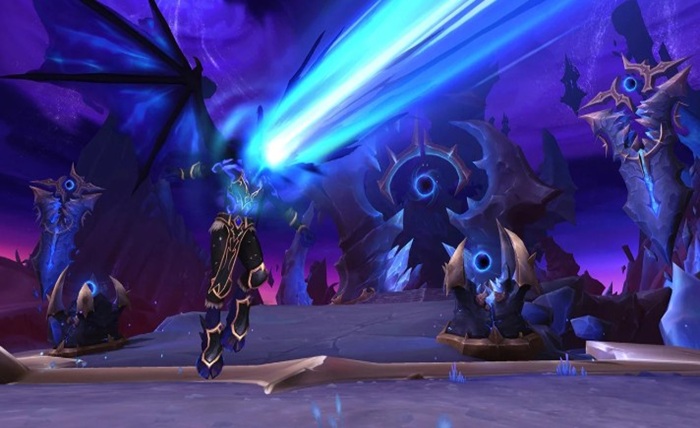
Every raid tier tells the same story. Thousands of guilds clear the raid on Heroic, celebrate, and turn their eyes to Mythic — the final difficulty, the prestige mounts, the hall-of-fame race they have watched from afar. Most of them will kill a handful of bosses and stop. The Heroic-to-Mythic jump is the sharpest filter in WoW’s endgame, and it filters on more than skill.
The Difficulty Cliff, Explained
Heroic and Mythic are not adjacent steps on a staircase; there is a cliff between them. On Heroic, encounters forgive: a death can be covered, a missed mechanic costs healing rather than the pull, and numeric requirements leave slack for a few underperformers. Mythic removes the slack by design. Bosses gain entirely new mechanics rather than bigger numbers, timers tighten until damage requirements assume near-optimal play, and mechanics interlock so that one person’s mistake cascades — the mispositioned player does not just die, they detonate the group, break the assignment chain, or force a cooldown that was budgeted for later. Encounters become choreography: every player has a spot, a job, and a timing, and the fight audits all twenty of them continuously. The honest description is that Heroic tests whether your raid can execute mechanics, while Mythic tests whether your raid can execute them simultaneously, repeatedly, and without anyone hiding.
The 20-Man Roster Lock Problem
Before a single pull, Mythic imposes an organizational filter that has nothing to do with talent: the fixed twenty-player roster. Flexible sizing — the quiet convenience that lets Heroic groups raid with whoever showed up — disappears, and with it disappears tolerance for absence. A Mythic guild needs exactly twenty prepared players every raid night, which in practice means carrying twenty-four to twenty-six and managing the politics of who sits. That bench is expensive in human terms: capable players spend progression nights waiting, and capable players have options. The roster lock is why so many guilds stall at the doorstep — not because their best twenty cannot do the content, but because assembling the same twenty, week after week through a long tier, is a logistics problem most volunteer organizations cannot sustain. Mythic’s first boss, veterans like to say, is the spreadsheet.
Personal Responsibility: No More Carrying Weight
Heroic rosters quietly carry passengers — the pleasant player whose damage is modest, the healer who panics but has friends in the group. Everyone knows; the content absorbs it. Mythic is the difficulty where absorption ends. When a fight assigns individual responsibilities — your debuff, your position, your interrupt in your window — average play stops being a private shortfall and becomes the visible reason the evening produced nothing. This is the jump’s psychological filter, and it is harsher than the mechanical one. Players who comfortably enjoyed raiding for years suddenly find their name in the wipe analysis, repeatedly, in front of nineteen people. Some respond by improving fast. Others — including genuinely decent people — discover they do not want their hobby to audit them. Guilds crossing into Mythic lose members at exactly this point, and the losses are rarely about ability alone. They are about consent to scrutiny.
Why Most Guilds Stop After the First Bosses
The progression curve inside Mythic is itself a filter. Early bosses in a tier are typically tuned as an on-ramp — a coordinated Heroic-level roster can down them within a manageable number of pulls, and morale soars. Then the mid-tier wall arrives: encounters demanding cooldown spreadsheets, rehearsed positioning, and pull counts that climb into the dozens for a single new kill. Progress slows from bosses-per-week to weeks-per-boss. This is where the earlier filters compound: the roster lock makes every resignation a crisis, the scrutiny fatigues the fragile, and the calendar decay that afflicts every long commitment does its quiet work. A guild that entered the tier with twenty-six players finds itself at nineteen in the hardest month. The common endpoint is a respectable partial clear — the on-ramp bosses down, the wall unbroken — followed by a collective decision that Heroic was, on reflection, more fun.
Seeing Mythic Without a Mythic Guild
None of this means the difficulty is closed to players outside established Mythic guilds — the paths in are just less obvious. Late-tier entry is the patient route: as a season ages and gradual nerfs land, community groups form around partial clears, and standards relax enough for strong Heroic players with good logs to find seats. Learning communities run structured beginner nights on early bosses, trading speed for openness. And for players who want to experience the content directly — to stand in the fights, learn the choreography from inside, or secure a specific kill their schedule will never otherwise allow — an organized WoW raid carry with an experienced roster is the direct option, compressing the roster problem, the schedule problem, and the wall into a booked evening. Each path trades something — time, pace, or money. What they share is the acknowledgment that the barrier was never purely about how well you play.
Is the Jump Worth Making?
The honest answer depends on what raiding is for, in your particular life. Mythic offers things Heroic cannot: mechanical depth that rewards mastery, the sharpest team experience in the genre, and accomplishments that stay meaningful precisely because they filtered almost everyone else out. It charges accordingly — in hours, in scheduling rigidity, in tolerance for being measured. Heroic, meanwhile, delivers most of the spectacle, the full story, and a satisfying challenge for a fraction of the cost; for many rosters it is not a consolation prize but the correct stopping point. The healthiest framing is a budget question rather than a pride question: Mythic is worth it when you would spend those evenings raiding anyway and want the audit, and not worth it when you would be paying in burnout for a difficulty label. The cliff is real. Climbing it is optional — and so, it turns out, is regretting the choice not to.
